Coronary Artery Disease Treatment Package - Coronary Angiography
What's included in this package
Medical Procedures
- Coronary stenting
- Coronary angiography
- 3 meals per day by nutritionist
- 24-hr nurse services
- Consultation with a cardiologist
Duration
- 2 days in the hospital
- 3 days in the hotel
Accommodation
VIP Room
Transport
Transfer airport-clinic-airport
Additional information
Coronary Artery Disease Treatment Package Coronary Angiography (CAG) Price: 64,500 THB 2 days, 1 night
Coronary Angiography (CAG) Package
24/7 Bookimed assistance
- Personal medical coordinator
- Medical travel arrangements — booking of air tickets and hotel rooms at special partner prices
- Patient advocacy during medical travel
Program price
What's NOT included in this package
Doctor
Dr. Sarunyoo Suttipongkeat is an interventional cardiologist at PMG Hospital in Bangkok. He earned his medical degree with Second Class Honors from Mahidol University. Dr. Suttipongkeat has performed over 37,900 procedures during his career. He specializes in treating coronary artery disease, arrhythmia, and chronic heart failure.
- Performs coronary angiography and carotid angioplasty with stenting.
- Provides stem cell therapy for heart disease patients.
- Completed a clinical fellowship in interventional cardiology at Siriraj Hospital.
- Works at PMG Hospital, a GHA-accredited facility for international patients.
How are we doing?
About the clinic
PMG Hospital is a private multispecialty facility in Bangkok, Thailand. It focuses on cardiology, orthopedics, and pediatrics. The hospital also offers obstetrics, gynecology, and rehabilitation. Pediatric services treat children from birth to age 15. A 24-hour critical care center provides intensive monitoring by specialist physicians.
PMG Hospital opened in 1992 and has 109 beds. There are 36 patient rooms, including private VIP suites. The PMG Heart Center offers full-cycle cardiac care. This covers diagnostics, interventional treatments, and rehabilitation. For stroke recovery, the rehab team uses PMS electromagnetic stimulation, therapeutic exercises, and electrical appliances.
International patients get help with medical visa extensions, translation, and airport transfers. Diagnostics rely on digital radiography and CT scanners. Cardiovascular screening includes carotid intima-media thickness ultrasound. This test detects heart disease risk without radiation.
Payment & Rewards
You don’t pay for our services
You make your payment directly at the clinic or to their official bank account.
Some clinics may require a deposit as a part of their policy.
Spread out your payments with installment options.
Earn rewards for referring friends to Bookimed.
Why people love us
Patient reviews
Our top offers for you
FAQ
Indications and contraindications to coronary stenting
Coronary stenting is used to treat atherosclerosis (narrowed arteries) and heart attacks as well as addressing the following symptoms:
- breath shortness;
- pain;
- faintness.
All these symptoms pose an indication for undergoing an intravascular ultrasound to assess the location and size of plaque that is obstructing a blood flow.
Contraindications to coronary stenting include:
- narrowed artery (for cases when narrowing was not caused by atherosclerosis);
- weak or damaged heart muscle;
- malfunctioning or diseased blood vessels;
- diabetes;
- multiple blockages.
Preparation for coronary stenting
Before the surgery, a doctor assesses patient’s medical history. An imaging test called coronary angiogram is performed. During this test, liquid dye is introduced into patient’s blood flow through a catheter in their wrist or groin area. Dye is visible on X-ray, allowing to locate and plan treatment of blood flow blockages.
Based on patient’s examination results, a doctor decides, if the procedure is viable and what type of stent should be used and what clinic to choose. According to this Doctor Coordinator will answer how much does angioplasty surgery cost in your particular case.
Routine examinations are carried out before the operation: blood tests, chest X-ray, and an electrocardiogram to rule out contraindications and get a better grip on patient’s condition.
Patients should not take any medicine that interferes with blood coagulation or thickness. Any medications should be taken only in accordance with a physician.
Coronary stenting process
The procedure takes 1-3 hours depending on patient’s condition, a number of blockages and difficulty. The operation is carried out by a cardiac surgeon and a team of medical personnel in a cardiac catheterization lab. The procedure is as follows:
- a patient is administered local anesthesia to numb the pain from the incision;
- a small incision is made on the wrist or in the groin area to gain access to the artery;
- a catheter is then inserted in the artery and guided to the blockage location through the blood flow;
- using X-ray imaging and previous examination data, a doctor places an unopened stent into the blockage;
- a small balloon on the catheter is inflated, setting up a stent and stretching the artery;
- the balloon is deflated and the catheter removed from patient’s artery.
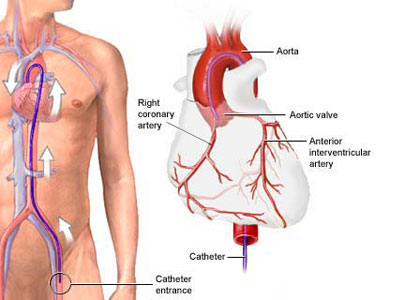
Catheterization process
Rehabilitation
After the operation patients are required to stay in a hospital for 1-4 days. Usually, special medications and regimen are not needed but may be implemented depending on patient condition. Patients should note that heart stent price is influenced by their duration of hospital stay. After a patient is dismissed, they should follow doctor’s recommendations.
Following symptoms should be addressed immediately by calling the operating doctor or the hospital:
- catheter area starts bleeding or swelling;
- a feeling of discomfort or pain in the catheter insertion site;
- redness, fever, swelling;
- signs of blood shortage in limbs (numbness, color change, temperature decrease);
- a feeling of weakness;
- chest pains, windedness.
Risks
The procedure is considered minimally invasive and low risk. Still, there is a small chance (under 8%) of complications. Operating physicians will address them on the first notice and that won’t influence the heart stent surgery cost.
- Blockage recurrence. There is a small chance of restenosis (re-narrowing) of the artery after the procedure. The risk of blockage forming again is estimated to be under 10%.
- Blood clotting. Blood clots may form within the stent and cause strokes or heart attacks. To avoid this a patient is prescribed medication that prevents blood clotting.
- Bleeding in the catheter incision area. While not an unusual occurrence, profuse bleeding may require medical attention and blood transfusion.
- Artery damage. During the operation patient’s artery may be damaged. This complication is treated with bypass surgery.
- Arrhythmical heartbeats. During the procedure, the heart may start beating irregularly. This condition is treated with appropriate medication and does not extend over the postoperative period.
Outlook
The success rate of the procedure is over 90%. Placed stent greatly improves blood flow and a patient feels almost immediate relief after the operation. Patients are free to return to their usual lifestyles after a short rehabilitation period of about a week. A physician will tell when excessive activities may be engaged.
It should be noted that stenting doesn’t cure the disease, but rather neutralizes the symptoms. To support and prolong the healthy state, one needs to:
- exercise regularly;
- monitor vital parameters, such as sugar levels and blood pressure;
- control body mass and implement diets if required;
- quit smoking;
- consume less cholesterol, reduce current cholesterol levels.
Angioplasty cost
Heart stent cost depends on the following factors:
- Patient condition. Total heart catheterization cost is affected by the duration of patient’s overall hospital stay. Additional stabilizing procedures and medications also influence angioplasty surgery cost.
- Type of used stent. Cardiac catheterization cost is different for each type of stent. A cardiac surgeon will assess patient’s state and suggest what type of stents should be used in a particular case. Angioplasty price mostly depends on this choice.
- Location. The answer to the question how much does angioplasty surgery cost varies depending on the country. Angioplasty operation costs in Turkey or India are 10-12 times lower than in the USA and 2-3 times lower than in Germany or Israel. Note that the clinics in question operate with the same success rate and service quality.
- Operation difficulty. Angioplasty stent price increases if a patient has several arterial blockages that need stenting. Beside increased cardiac stent cost it also requires more time from medical staff.
- Screening method used during the procedure. Type of imaging device and the duration of its use also influence the cost of heart catheterization procedure.
How to receive coronary stenting abroad?
To receive coronary stenting overseas, submit a request on Bookimed site. In the shortest terms our Medical Coordinator will consult you via phone call. You will receive all information needed to find the best place to undergo the procedure, how much does a heart stent cost surgeons’ experience, hospital accreditation. Bookimed will assist you with your paperwork and organize your trip abroad.